

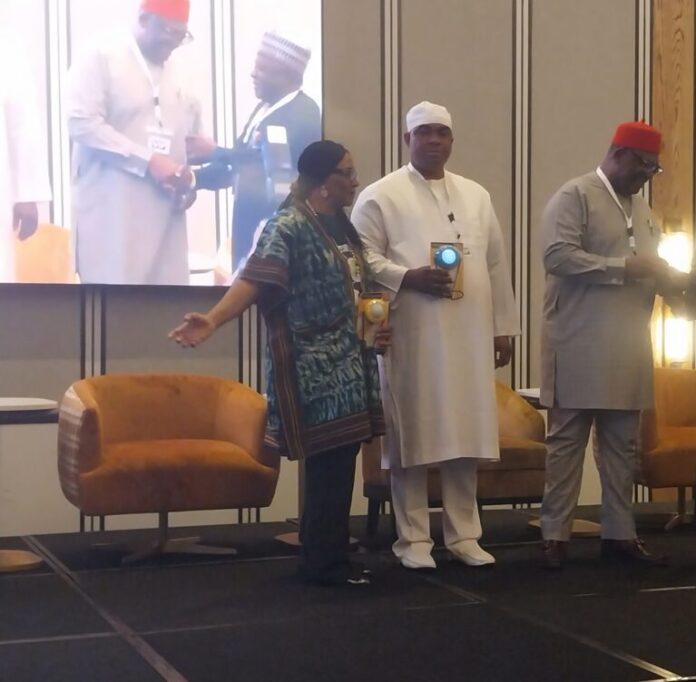
The Federal Government has called for the removal of structural barriers limiting women’s leadership in the green economy, while calling for more access to capital, technology and markets.
The Minister of Regional Development, Mr Abubakar Momoh, made the call on Tuesday at the Women’s International Green Summit and Exhibition (WIGSE-26) in Lagos.
Momoh, represented by Dr Okodugha Dauda, Vice President, Corporate Services, Nigerian Society of Engineers for the 2026 executive committee term, said women were already driving innovations in renewable energy, climate-smart agriculture, recycling and clean cooking.
He said the government must move beyond inviting women to participate in the green transition and create conditions that would enable them to lead it.
“Our responsibility is not simply to invite women into the green transition. It is to remove the structural barriers that prevent them from leading it,” he said.
The minister said innovation could not thrive without supportive policies, while meaningful inclusion required deliberate institutional action and sustainable impact depended on access to capital.
He said the green economy must create opportunities for women to own enterprises, control productive assets and participate fully in economic development.
According to him, the transition should generate jobs, strengthen food security, expand energy access, improve public health and build resilient communities.
Momoh said the Ministry of Regional Development would promote gender inclusion, environmental sustainability and climate resilience across its programmes.
He said regional development should go beyond roads and physical infrastructure to encompass human resilience, local economies, ecosystems and livelihoods.
The minister cited solar-powered streetlights installed across Niger Delta communities as an example of interventions that had improved mobility, extended commercial activities and enhanced security.
He said the interventions were particularly beneficial to women traders and small businesses whose operations were constrained by inadequate electricity.
Momoh also highlighted programmes supporting women through entrepreneurship, agriculture, international trade, skills development and access to markets.
He said the Niger Delta Agricultural Development Investment Fund could help women transition from subsistence farming to commercially viable, climate-smart value chains.
The minister said regional development commissions were also supporting women and youths through empowerment, agriculture, livelihood restoration and community resilience programmes.
He said the ministry would deepen collaboration with government agencies, financial institutions, development partners, private organisations and civil society to expand opportunities for women.
Momoh said the ministry was ready to work with WIGSE organisers to translate summit resolutions into practical partnerships capable of creating sustainable livelihoods, resilient communities and investable women-led green enterprises.
He cautioned that the green economy must not become another sector where women provide informal labour while ownership, technology and capital remain concentrated elsewhere.
Earlier, the President of the Women in Renewable Energy Association (WIRE-A), Dr Anita Nana-Okuribido, identified inadequate finance as the biggest barrier to women’s participation in the energy transition.
“Number one barrier is finance. Without finance, honestly, we cannot go into energy transition,” Nana-Okuribido said.
She also identified tradition and weak implementation of policies as major obstacles to women’s participation in the green economy.
Nana-Okuribido urged policymakers to give women a voice in decisions on energy, climate policy and green investment.
“Inclusion is making sure that the woman has a voice in the decision-making of the green space,” she said.
She said solar power could provide sustainable electricity to rural health facilities and support critical services, including medicine storage.
Nana-Okuribido urged stakeholders to extend renewable energy interventions to rural communities where energy poverty remained a major challenge.
She said the summit would position women as leaders, innovators, investors, entrepreneurs, policymakers and solution providers in Africa’s green transition.
The theme of the summit is “Empowering Women to Lead Africa’s Green Transition: Enhanced by Innovation, Inclusion and Impact”, brought together policymakers, investors, entrepreneurs and women leaders.
Also, Sen. Augustine Akobundu, Deputy Chairman, Senate Committee on National Planning and Economic Affairs, described climate change as an economic and national security challenge.
“Climate change is not merely an environmental hazard. It is an economic imperative, a national planning priority, and a security challenge,” Akobundu said.
He said he would advocate greater prioritisation of renewable energy projects in the national budget.
Akobundu said governments needed private-sector investment, innovation and stronger partnerships with organisations promoting renewable energy.
The Governor of Osun, Mr Ademola Adeleke, said women needed access to skills, technology, finance, markets and policy platforms to lead the green transition.
Adeleke, represented by his Director-General and Special Envoy on Climate Change and Renewable Energy, Prof. Chinwe Obuaku, said the state had implemented solar energy, recycling and waste-management initiatives aimed at expanding energy access and creating green jobs.
The summit also featured high-level panel sessions on women’s leadership, green entrepreneurship, investment and sustainable economic growth.
Mrs Chioma Aninwe, Chairman of the WIGSE-26 Organising Committee, said the summit sought to make women’s leadership central to Africa’s green transition.
Aninwe said the summit would promote opportunities for women in renewable energy, climate action, sustainable agriculture, green finance and green technology.

