

By Alex Ekemenah
Chairman of Heirs Holdings and founder of the Tony Elumelu Foundation, Mr. Tony Elumelu, has challenged African women, investors and business leaders to take ownership of the continent’s economic future, declaring that Africa’s greatest asset is not its natural resources but its people, particularly its women.
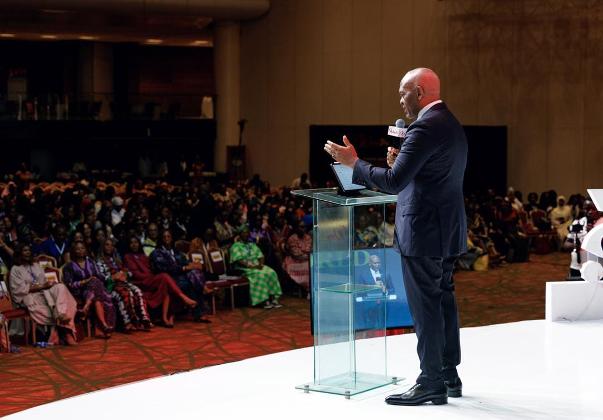
Delivering the keynote address at the 25th anniversary conference of Women in Management, Business and Public Service (WIMBIZ) in Lagos, Elumelu argued that Africa stands at the centre of the world’s next major growth story, but warned that the continent must address critical infrastructure, capital and governance challenges to realise its potential.
Speaking on the theme, “The Geography of Opportunity: Why the World Needs What Africa Has,” Elumelu said Africa’s rapidly growing population, natural resources and youthful workforce give it a unique competitive advantage in a changing global economy.
“The world needs what Africa has,” he told participants, pointing out that “This is the single greatest commercial opportunity of this century, and it is ours.”
Africa’s Opportunity Must Be Built, Not Assumed
Drawing comparisons with Singapore and South Korea, Elumelu said Africa’s natural wealth alone would not guarantee prosperity.
According to him, three major barriers continue to stand between the continent and its economic transformation: unreliable electricity, limited value addition to raw materials, and insufficient capital investment.
“We cannot talk about industrialisation without fixing electricity,” he said, adding that reliable power is essential not only for manufacturing but also for emerging sectors such as artificial intelligence and digital services.
He also urged African countries to move away from exporting raw materials and instead focus on processing and manufacturing products locally.
“If the power is reliable and the environment is right, why ship raw lithium, raw cocoa and raw crude out of this continent? Refine it. Process it. Brand it. Then sell it to the world,” he said.
Elumelu further argued that the era of dependence on foreign aid is ending and must be replaced by investment-led growth driven largely by Africans themselves.
“Aid kept people alive. It rarely made them owners. The future is investment and trade, not aid,” he said.
Call for More African Capital
The businessman made a strong case for mobilising Africa’s savings and investment capital, stressing that local pension funds, insurers, banks and family offices must play a larger role in financing African enterprises.
He cited investments in Seplat Energy and the Dangote Refinery public offering as examples of how African capital can create wealth and economic value on the continent.
The founder of the Tony Elumelu Foundation also highlighted the foundation’s more than $130 million investment in African entrepreneurs as proof that strategic capital deployment can drive job creation and economic growth.
“The narrative will not change because we talk about it. It will change by Africans taking control of their destiny,” he said.
Women Are Central to Africa’s Development
A central theme of Elumelu’s speech was the importance of women’s economic participation and leadership.
Reflecting on his personal journey, he credited his mother, a small business owner, with teaching him his earliest lessons in entrepreneurship, resilience and financial management.
“So, when people ask me whether women can lead African business, I find the question strange,” he said. “In my experience, they already do. We have simply not given them the capital, the title or the credit.”
Elumelu revealed that nearly half of the 24,633 entrepreneurs funded by the Tony Elumelu Foundation across all 54 African countries over the last 15 years are women.
Those businesses, he said, have collectively created more than 1.5 million jobs and generated over $4.2 billion in revenue.
He highlighted the stories of three female entrepreneurs supported by the foundation, including coffee entrepreneur Princess Adeyinka Tekenah, recycling business founder Olamide Ayeni-Babajide and fintech entrepreneur Nkem Okocha, as examples of the transformative impact of small-scale investments.
“Women’s economic leadership is not a concession to fairness. It is a requirement for competitiveness,” he said, adding that “Inclusive prosperity is not charity.”
Showcasing Female Leadership
Elumelu also pointed to the growing number of women leading companies within the Heirs Holdings ecosystem and the United Bank for Africa Group, insisting that appointments were based on competence and performance rather than quotas.
He cited the appointments of Dr Awele Elumelu, Owen Omogiafo, Uzo Oshogwe and Somachi Chris-Asoluka among several female executives occupying key leadership positions across banking, hospitality, healthcare, insurance and energy businesses.
“I did not do it for a headline,” he said. “I did it because they were the best people for the jobs.”
He challenged corporate leaders across Africa to examine their own organisations and ask why more women are not being promoted into senior leadership positions.
“To the men in this room, the women you promote will not thank you with loyalty alone. They will thank you with results,” he said.
Strong Institutions Remain Critical
Beyond entrepreneurship and investment, Elumelu stressed the importance of strong institutions, good governance and predictable regulatory environments in attracting long-term investment.
He urged African governments to create conditions that encourage business growth, while also calling on private sector leaders to embrace transparency, meritocracy and accountability.
“Capital goes where it is safe, and it stays where it is respected,” he said.
A Call to Action
In his closing remarks, Elumelu argued that Africa’s future will ultimately be determined by Africans themselves, not by international donors or development partners.
Addressing young women in the audience, he encouraged them to seize opportunities rather than wait for them.
“Do not wait. Build the business. Take the board seat. Deploy the capital,” he said.
Congratulating WIMBIZ on its 25-year journey, Elumelu urged the organisation to continue advancing women’s economic empowerment through access to capital and leadership opportunities.
“Born in Africa. Built for the world. The world needs what Africa has,” he concluded. “And what Africa has, more than oil, more than lithium, more than land, is you.”

