

United Capital Plc has recorded an 80 per cent growth in profit before tax (PBT) in the first half of the year to N24.78 billion as against N13.79 recorded in the corresponding period of 2025.
The Group Chief Finance Officer, Mr Shedrack Onakpoma, said this was driven by disciplined execution of the company’s growth strategy, improved operational efficiency and sustained investments in digital capabilities.
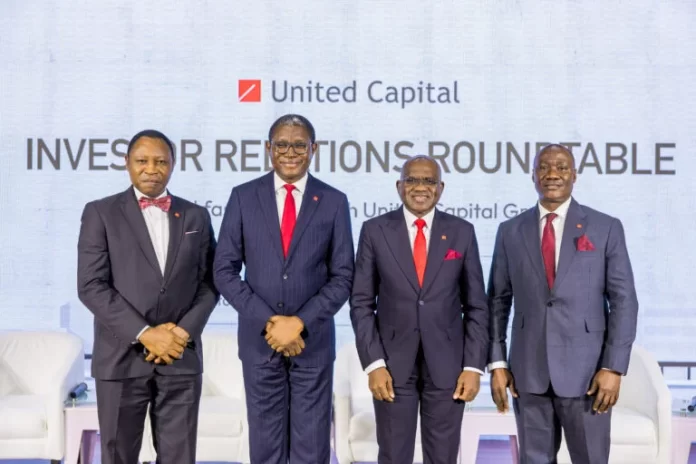
Onakpoma disclosed this on Wednesday during the company’s Investor Relations Roundtable with the theme “Decoding Performance: Insights into United Capital’s Growth Drivers and Outlook” held in Lagos.
He said the group’s gross earnings rose by 58 per cent to N37.49 billion, reflecting the resilience of its diversified business model and continued execution of its growth strategy.
According to him, profit after tax increased by 77 per cent to N21.10 billion, from N11.89 billion recorded in the corresponding period of 2025.
He added that shareholders’ funds grew by 25 per cent to N187.09 billion, compared with N149.99 billion as of Dec. 31, 2025.
“The numbers tell a story beyond revenue growth and profitability. They reflect how we are building a resilient institution, creating sustainable value across multiple markets and laying the foundation for a lasting legacy,” he said.
Onakpoma said the stronger growth in profit relative to revenue highlighted the group’s operational efficiency and returns on its investments in digital infrastructure.
He noted that the company’s cost-to-income ratio improved to 44 per cent, from 50 per cent in the corresponding period of 2025.
He attributed the performance to growth across its core businesses, with fee and commission income rising to N14.3 billion from N11.3 billion, while investment income increased to N13.8 billion from N9.6 billion.
The finance chief said the group also strengthened its balance sheet by exiting underperforming assets and reducing high-cost borrowings, resulting in improved returns and greater financial resilience.
According to him, cash and cash equivalents increased to 24 per cent of total assets, from 16 per cent at the end of 2025, enhancing liquidity and positioning the group to seize emerging investment opportunities.
He said the interim dividend of 30 kobo per share reflected the company’s commitment to balancing shareholder returns with long-term growth.
Onakpoma reaffirmed United Capital’s commitment to disciplined execution, prudent risk management and sustainable value creation across Nigeria and other African markets.
Speaking on the economic outlook, the Chief Economist of United Capital Plc, Mr Ayodele Akinwunmi, said ongoing reforms by the Federal Government and the Central Bank of Nigeria (CBN) were strengthening macroeconomic fundamentals and creating attractive investment opportunities.
He said rising non-oil exports, increasing diaspora remittances and improved foreign exchange inflows were boosting investor confidence and supporting economic stability.
According to him, exports of refined petroleum products, aviation fuel and fertiliser were diversifying Nigeria’s foreign exchange earnings and easing pressure on the external sector.
“International investors are responding positively to ongoing reforms, while Nigerians in the diaspora are also increasing investments in the country.
“United Capital is actively supporting diaspora remittances and helping investors understand opportunities created by the reforms,” he said.
Akinwunmi also identified Nigeria’s lithium deposits as a strategic asset capable of positioning the country to benefit from the global transition to electric vehicles.
He said the company was engaging investors and corporate organisations to unlock opportunities across the solid minerals value chain through structured investments.
Looking ahead, Akinwunmi projected that interest rates would moderate in the second half of 2026, creating a more favourable environment for business expansion and lower borrowing costs.
He said United Capital expected the Nigerian equities market to deliver about 11.6 per cent growth in the second half of the year, driven by banking, building materials, consumer goods and oil and gas stocks.
He also projected that the naira would remain stable and could appreciate to about N1,360 per dollar by year-end, supported by stronger external reserves, reduced foreign exchange demand and increased capital inflows.

