

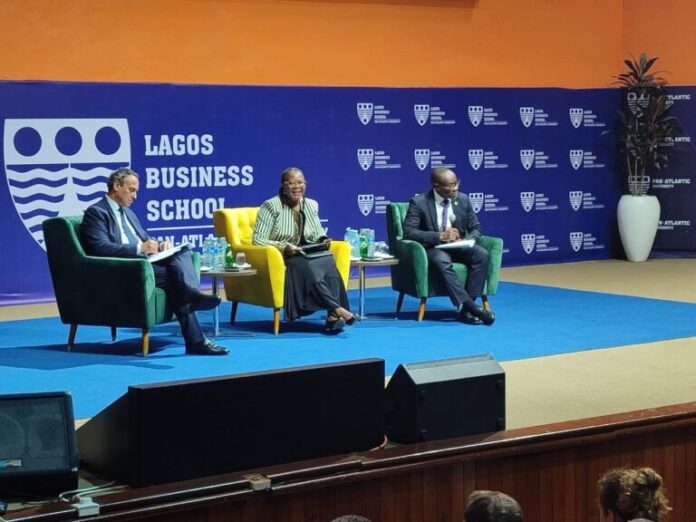
Nigerian and French stakeholders have called for stronger collaboration in education, agribusiness, technology, innovation and human capital development to deepen bilateral relations and drive sustainable economic growth.
They made the call on Wednesday in Lagos at the France-Nigeria Business and Human Capital Development Forum by the Lagos Business School (LBS).
The event has as its theme: “Strengthening France- Nigeria Partnerships through Business, Innovation, Human Capital and Executive Education”.
Ambassador of France to Nigeria, Marc Fonbaustier, described Nigeria as Africa’s largest economy and a major reservoir of entrepreneurial talent and creativity.
Fonbaustier said France and Nigeria currently enjoyed a dynamic partnership capable of creating opportunities beyond traditional diplomatic and commercial engagements.
“France brings world-class expertise in research, higher education, innovation, sustainable agriculture, technology and industry, while Nigeria offers immense talent, creativity and economic potential.
“When these strengths come together, they create opportunities greater than the sum of their parts.
“Our partnership is about building ecosystems, strengthening institutions and empowering people,” he said.
The ambassador identified agriculture as a critical pillar of bilateral cooperation, noting that the sector had evolved beyond food production to encompass innovation, climate resilience, food security and digital transformation.
According to him, French expertise in agritech, sustainable farming, logistics and agro-processing can complement Nigeria’s agricultural potential to strengthen food systems and rural economies.
He also emphasised the importance of academic exchanges, joint research and student mobility, describing them as strong foundations for long-term cooperation.
Fonbaustier said women and young people remained Nigeria’s greatest strategic assets, stressing the need to support their education, entrepreneurship and leadership development.
He further urged both countries to deepen collaboration in addressing climate change through renewable energy, climate-smart agriculture and green innovation.
“The future of France-Nigeria relations will not be written only in diplomatic meetings. It will be written in laboratories, classrooms, start-ups and partnerships such as the one we celebrate today,” he said.
Mrs Olayinka David-West, Dean, LBS, said the forum reflected the enduring relationship between France and Nigeria and a shared commitment to building stronger institutional and business ties.
David-West said the relationship between both countries held enormous potential for economic growth, innovation, talent development and sustainable impact.
“In a world characterised by rapid technological change, economic uncertainty and shifting workforce dynamics, partnerships have become more important than ever.
“The relationship between France, one of the world’s leading economies and centres of innovation, and Nigeria, Africa’s largest economy and one of the continent’s most dynamic markets, holds tremendous promise,” she said.
She noted that cooperation between the two countries extended beyond trade and investment to human capital development, institutional capacity building and innovation.
According to her, discussions at the forum focused on agribusiness and food systems, technology and artificial intelligence, executive education, academic exchange, research collaboration and student mobility.
David-West noted that Nigeria remained France’s largest trading partner in Sub-Saharan Africa for three consecutive years and its leading destination for foreign direct investment in the region.
She added that more than 100 French companies currently operated across key sectors of the Nigerian economy.
Also, Prof. Adi Bongo, Professor of Economics, LBS, said the France-Nigeria relationship must evolve from its traditional focus on trade, diplomacy and energy to innovation, education, entrepreneurship, technology and sustainable development.
Bongo identified artificial intelligence, digital transformation, energy transition, food security and demographic change as five major forces shaping future cooperation between both countries.
He said Nigeria’s youthful population, large market, vibrant technology ecosystem and strategic position under the African Continental Free Trade Area offered significant advantages for deeper engagement.
According to him, France brings strengths in research excellence, executive education, innovation ecosystems, development finance, technology and industrial expertise.
Bongo identified key opportunities for collaboration in agribusiness, digital innovation, skills development, research, academic exchange and climate transition.
He said LBS was positioning itself as a knowledge partner, research hub, capacity-building institution and platform for public-private dialogue to support a new model of bilateral partnership.
The economist outlined five pillars for a transformational France-Nigeria partnership: business and investment, technology and innovation, human capital development, research and academic exchange, and sustainability.
He expressed optimism that stronger collaboration across these areas would deliver tangible outcomes and deepen bilateral relations by 2030.

