

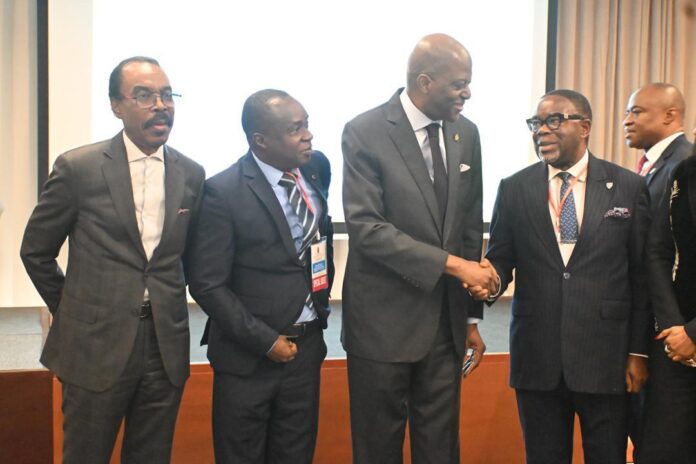
Emeka Osuji, Professor of Economics at Pan-Atlantic University, has called for coordination of fiscal and monetary policies and strengthening of synergy between fiscal/monetary authorities and the private sector to achieve sustainable macroeconomic stability.
Osuji made the call at the first 2026 Monetary Policy Forum organised by the Central Bank of Nigeria (CBN) in Abuja recently.
Osuji who was the lead speaker at the forum, said strengthening the synergy between fiscal/monetary authorities and the private sector would require regular dialogue between the fiscal/monetary authorities and all segments of the private sector. Demphasising empire building, territory controls, encouraging discipline and information sharing, he said, are also a major requirement for achieving coordination of monetary and fiscal policies and synergy between fiscal/monetary authorities and the private sector.
Osuji also believes that achieving good coordination of fiscal and monetary policies and synergy between fiscal/monetary authorities and the private sector would require a restructuring and re-establishment of policy coordination frameworks, maintaining CBN independence, strengthening of fiscal responsibility frameworks and improving policy communication.
Osuji whose presentation was entitled Strengthening Synergy Between Fiscal/Monetary Authorities and the Private Sector for Sustainable Macroeconomic Stability, said to achieve this objective, there is a need to promote fiscal transparency with emphasis on budget discipline, place/observe limits on deficit monetisation, place/observe fiscal rules such as deficit/GDP limits, strengthen CBN’s independence, and communicate more equitably to markets.
Other things which he said must done to achieve synergy between fiscal/monetary authorities and the private sector include institutionalising fiscal-monetary coordination, enhancing policy transparency, strengthening financial markets to improve liquidity/transmission and encouraging inclusive private sector-led development.
Speaking further, Osuji said there is need for fiscal/monetary authorities to publish timely a macroeconomic coordination report, develop shared data systems for liquidity, revenue and inflation forecasting, align intervention programmes with national industrial realities, and co-design countercyclical tools for responding to external shocks.
Finally, he said that coordination and synergy of fiscal and monetary policies are critical now because the times are uncertain, pointing out that there is evidence that a coordinated policy mix in fiscal and monetary policies is vital in tough times and a difficult environment.

