

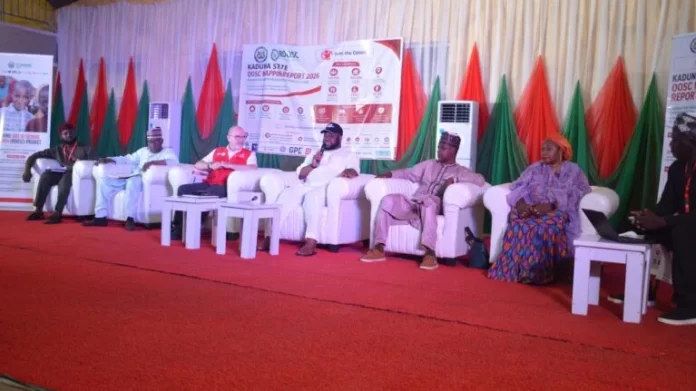
Save the Children Nigeria has led a media engagement highlighting Kaduna State’s landmark Out-of-school children mapping under the Reaching Out-of- School Children (ROOSC) Project.
The engagement underscored the importance of evidence-based planning to reduce the number of out-of-school children across Kaduna State’s 23 local government areas.
The five-year ROOSC Project is implemented by the Kaduna State Government with support from Save the Children International, Education Above All, Global Partnership for Education, UNICEF and other development partners.
The Islamic Development Bank and Kuwait Fund for Arab Economic Development also support the project through loans and grants.
Save the Children leads the project’s service delivery component, focusing on community mobilisation, enrolment, retention and inclusive education for vulnerable children.
UNICEF supports the project’s system strengthening component to ensure sustainable education reforms beyond the project’s lifespan.
The Kaduna State Bureau of Statistics implemented the statewide mapping exercise, providing credible evidence to guide government planning and interventions.
Speaking at the engagement on Thursday, Save the Children Nigeria Country Director, Duncan Harvey, described the mapping as a landmark achievement with national significance.
Harvey said Kaduna had become the first state to comprehensively identify where out-of-school children live through a detailed household mapping exercise.
He said the findings would enable government to identify affected local governments, wards and households for targeted interventions.
According to him, many states would benefit from similar evidence to strengthen education planning and budgeting.
Harvey said the project had already identified about 187,719 out of school children across Kaduna State.
He said the mapping would enable the project to target children most in need during the remaining implementation period.
Harvey stressed that every child, regardless of background, deserved access to quality basic education.
He reaffirmed Save the Children’s commitment to advancing children’s rights through education, health, nutrition, child protection and livelihood programmes.
He said the organisation’s work aligned with its Ambition for Children 2030 strategy and Sustainable Development Goal Four on quality education.
Harvey noted that the organisation prioritised learning outcomes, teacher support, alternative learning pathways, inclusion and school retention.
He said the project represented a strong partnership among government, donors and development organisations working towards shared education goals.
ROOSC Project Coordinator, Mr Ezra Angai, described the initiative as Kaduna State’s flagship response to the out-of-school children crisis.
Angai said the project adopted a holistic and collaborative approach involving multiple partners with clearly defined responsibilities.
He said Save the Children exceeded its first year enrolment targets through intensive community engagement and household mobilisation.
According to him, UNICEF has strengthened school systems through institutional capacity building and community-based education structures.
Angai said the project aimed to return 100,000 out-of-school children to classrooms across Kaduna State.
He explained that the new mapping provided accurate information to guide resource allocation and intervention planning.
Angai said poverty remained the leading factor keeping many children, particularly boys, out-of-school.
He said many boys were engaged in farming, hawking and other income generating activities to support their families.
The coordinator said the findings would help government design integrated interventions addressing both education and household economic challenges.
He added that collaboration with school feeding and social protection programmes would further support vulnerable families.
Statistician General of the Kaduna State Bureau of Statistics, Dr Bukar Baba Alhaji, said the mapping covered all 23 local government areas.
He said over 360,000 households were visited using geospatial mapping and digital data collection technology.
Alhaji said more than 1,200 trained enumerators participated under strict supervision and quality assurance procedures.
He said telephone verification, field monitoring and callback visits strengthened the credibility of the collected data.
According to him, the mapping identified 187,719 out-of-school children across Kaduna State.
He said 60.2 per cent of affected children had never enrolled in school.
He added that 39.8 per cent had enrolled previously but later dropped out.
Alhaji said children aged between six and 10 accounted for 64.6 per cent of those identified.
He said boys represented 56.7 per cent of the mapped out-of-school population, while girls accounted for 43.3 per cent.
He identified Kubau, Giwa, Makarfi, Soba and Igabi among local governments with the highest numbers.
He attributed the situation to poverty, insecurity and other socio economic challenges affecting school attendance.
Director of Planning, Research and Statistics at the Ministry of Education, Mallam Salisu Lawal, said the ministry required reliable data to address the challenge.
Lawal said the mapping went beyond identifying children by investigating why they remained outside school.
He said the findings would guide targeted interventions suited to individual community needs.
He reaffirmed the ministry’s commitment to ensuring no child was left behind in accessing quality education.
He also highlighted Kaduna State’s commitment to inclusive education for children living with disabilities.
He said new school infrastructure was being designed to improve accessibility for learners with disabilities.
According to him, that specialised learning materials and teacher recruitment were being expanded to strengthen inclusive education.
Head of Education at Save the Children Nigeria, Richard Tekdek, said disability inclusion was integrated into the project’s design.
Tekdek said disability assessments were conducted to identify each child’s learning needs before support was provided.
He said Save the Children partnered with disability organisations, health professionals and government institutions to deliver tailored interventions.
He added that the project sought to ensure children with disabilities received equitable access to quality education.
Participants described the statewide mapping as a milestone expected to strengthen policy formulation, budgeting and targeted educational interventions.
They urged the media to amplify the findings nationally, describing Kaduna’s initiative as a model for addressing Nigeria’s out-of-school -children crisis.

