

By Ray Echebiri
It has a self-assigned mandate from get-go: To provide locally and value-added goods and services that meet the basic needs of the populace, generate employment, and prevent capital flight. This is to be achieved through the building and operation of large-scale manufacturing facilities in Nigeria and across other African countries.
Forty-seven years or so down the line, Dangote Industries Limited (Dangote Group) has transformed its dream of providing value-added goods and services across Africa into a reality. The Group currently operates in Nigeria and 17 other African countries – producing and providing tangible and value-added goods and services to the people.
Philosophy of Dangote Group
Seemingly, the Group’s operations are anchored on the philosophy “Charity begins at home”. For, all its manufacturing efforts start from the home country, Nigeria, before they begin to spread their tentacles to other parts of Africa. This is evidenced by the building and inauguration of its flagship cement plant at Obajana, Nigeria, in 2007, before it started building cement plants in other African countries. Today, Dangote Cement has operations in Cameroon, Ghana, Senegal, Ethiopia, South Africa, Zambia, Tanzania, Republic of Congo, and Sierra Leone.
Commitment to Nigeria’s economic transformation
As a demonstration of its passion and commitment to transform Nigeria’s economy, Dangote Group inaugurated its $2.5 billion Dangote Fertiliser Limited in March 2022. The plant which is the largest fertiliser manufacturer in Africa, produces three million metric tonnes per annum of Urea and Ammonia. Located in Lekki, Lagos State, the plant has capacity to meet local demand and also for the export market. Already, it is exporting to Brazil, India, the United States, and Mexico.
Just exactly what it did with cement – venturing out of Nigeria to other African countries after three years of producing and satisfying local demand for cement – Dangote Group has stretched its first tentacle to Ethiopia to set up a fertiliser plant in the Horn of Africa country after meeting Nigeria’s demand for the product.
Shareholding of Dangote and Ethiopia in the project
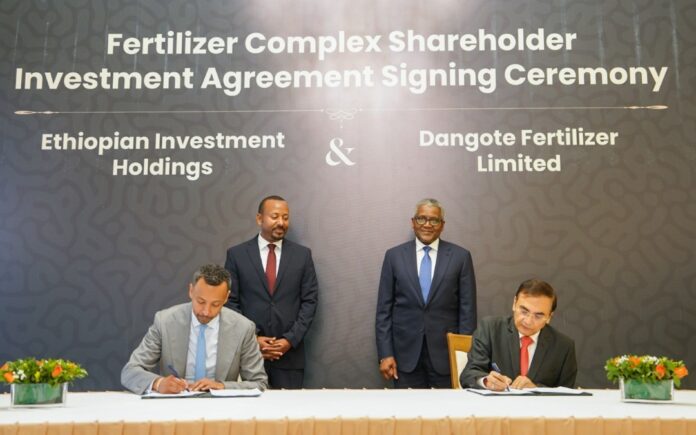
In a landmark deal in Addis Ababa, Ethiopia, last week, Dangote Industries and Ethiopian Investment Holdings (EIH) agreed to build a $2.5 billion Urea fertilizer plant in Gode, Somali region. The plant which will be completed within 40 months from date of commencement, will have a capacity of three million metric tonnes annually. Touted as one of Ethiopia’s largest industrial investments, the project hopes to reduce reliance on imports and position the country as a regional fertilizer hub. The project is one of the largest industrial investments in Ethiopia’s history, and also one of Africa’s largest industrial investments. Ethiopian government and Dangote Group holdings in the project will be 40% and 60% stakes, respectively.
In a statement on its website about the agreement, Dr. Brook Taye, Chief Executive Officer of Ethiopian Investment Holdings (EIH) said: “This landmark agreement with Dangote Group marks a significant milestone in Ethiopia’s journey toward industrial self-sufficiency and agricultural modernization. As the strategic investment arm of the government of Ethiopia, EIH is proud to secure a 40% stake in what will be one of the world’s largest Urea production facilities. The project aligns perfectly with our national development priorities and will substantially enhance our agricultural productivity while positioning Ethiopia as a regional hub for fertiliser production”.
Taye further stated that: “The utilization of our domestic Hilala and Calub gas reserves through dedicated pipeline infrastructure ensures energy security and competitiveness for decades to come. We are confident that this partnership will deliver tremendous value to Ethiopian farmers, contribute to food security, and generate substantial economic benefits for our nation”.
Throwing more light on the strategic impact of the project to Ethiopia, the EIH boss said: “The Gode fertiliser complex will play a crucial role in supporting Ethiopia’s agricultural sector which employs over 70% of the country’s population. By ensuring reliable access to high-quality fertilisers at competitive prices, the project is expected to boost crop yields, improve farmer incomes, and contribute to national food security objectives”, adding that: “The project positions Ethiopia as a major player in the global fertiliser market and a key supplier for the African continent”.
Taye pointed out that the partnership leverages Dangote Industry’s proven track record in large-scale industrial projects across Africa and Ethiopia Investment Holdings’ role as the government’s strategic investment vehicle with deep understanding of the local market and regulatory environment. He noted that the project also supports broader regional integration objective by creating a reliable supply of fertiliser for neighbouring countries, potentially reducing import costs and improving agricultural productivity across East Africa and beyond.
Commenting on the landmark fertiliser deal, President/Chief Executive Officer of Dangote Industries Limited, Alhaji Aliko Dangote, said: “This partnership with Ethiopian Investment Holdings represents a pivotal moment in our shared vision to industrialize Africa and achieve food security across the continent. The strategic location of Gode, combined with Ethiopia’s abundant natural gas resources from the Hilal and Calub reserves makes this an ideal location for what will become one of the world’s largest fertiliser complexes”. He assured that: “We are committed to bringing our decades of experience in large-scale industrial projects to ensure this venture becomes a cornerstone of Ethiopia’s industrial transformation and a catalyst for agricultural productivity throughout the region. The 60-40 partnership structure reflects our commitment to this transformative project while ensuring strong Ethiopian participation.”
Generally, the impact of the fertiliser plant will be quite huge. In terms of industrialization, the plant will be among the top five largest urea fertilizer complexes globally, producing up to three million metric tons of fertiliser annually, and it marks a shift from Ethiopia being a consumer of industrial goods to becoming a producer and exporter, especially in agro-industrial inputs.
In the area of infrastructure development, the project will lead to the construction of dedicated pipelines to transport natural gas from the Hilala and Calub reserves to the plant in Gode, and this infrastructure will support energy security, reduce costs, and lay the groundwork for future industrial projects.
The project will also lead to job creation and skills transfer as thousands of direct and indirect jobs will be created in the Somali Regional State. It will also foster technical training and industrial expertise, building a skilled workforce for Ethiopia’s future.
The impact of the project on agricultural production will be particularly huge. The project is expected to reduce Ethiopia’s fertiliser import, with analysist saying that local production will cut costs, ease foreign exchange pressure, and ensure reliable supply for farmers. It is also projected that the project will boost higher productivity, especially in cereals and cash crops, thereby ensuring food security in the country.
Experts also believe that the project will result in a transition to commercial agriculture because it aligns with Ethiopia’s 10-year development plan to move from subsistence farming to commercial agriculture, especially as reliable inputs will encourage private sector investment in agribusiness and agro-processing.
At the continental level, experts say that the Ethiopia-Dangote fertiliser deal will encourage intra-African investment and set a precedent for African-led industrial projects. They add that the deal will strengthen Ethiopia’s position in the African Continental Free Trade Area (AfCFTA) by boosting agro-industrial exports.
- Ray Echebiri is the Editor-in-Chief of NextMoney

