

By Alexander Ekemenah
For generations to come, it would be proclaimed to our children’s children that a Titan, an intellectual giant, a collosus, once passed through this realm – the Nigeria’s, nay Africa’s literary cosmic space and indeed, the global community. His statue would be inevitably erected in his hometown of Ibadan (Mesiogo) to remind future generations to come of who he was, what he was, and what he spent his entire life fighting for. His praise would be sung. His books and articles would be re-visited, researched, and reviewed. They would be studied and dissected over and over again. This prodigious intellectual of a man would be quoted in passages and verses of his radical ideological perbulum. His name would be whispered and even proclaimed loudly in awe or reverence – for daring to dedicate his entire life to speaking truth to power, for courage under fire of social tension and dissension, for empowering the young minds with the ability of critical thinking and for arming them with the epistemological ability or capacity of pedagogy and social activism. He would be remembered as a hero, a brave heart under various battles and skirmishes, a global literary collosus, a Marxist ideologue, and ultimately a lover of humanity without regard to race, gender and class. He would be remembered as a giant Iroko or an oak tree under whom the young ones took shelter and flowered.
The Making of a Man and Legend
Biodun (Abiodun) Jeyifo was born and raised in Ibadan, the land of ancient Yoruba warriors, barely a year after the Second World War. That may not be a coincidence. Why? Because BJ was to later grow up to become an intellectual warrior himself, as the first Commander (President) of Association of Nigerian Union of Universities (ASUU) (the umbrella body of all Nigerian university lecturers) leading battles to the front-doors of the mighty fortress of the Federal Government of Nigeria to make demands and negotiate for many things for the welfare of his Union members. He acquitted himself as a worthy commander. He bequeathed a legacy that still subsist until date, especially the courageous spirit of doggedly fighting for what is just and right, and of course, dialogue through negotiations for which ASUU is still known for today. In between is the intermediation of general activism that imbues social engagement with the diseased social order inherited from colonialism. To date, the diseased social order is yet to be healed and restored to health and healthy living for all.
In this contextual respect, BJ’s cause, course, and epic life trajectory is yet to be completed – until justice, equity, and fairness reign supreme in the land of Nigeria that we still call ours today.
BJ would become an intellectual afficionado, honing and homing his skills as a literary critic, embarking on a solo mission around the world especially in America and Europe, like a Ferdinand Magellan or a Vasco da Gama on mission or oddysey of discovery. BJ did not set out to conquer the world like Alexander the Great, or Napoleon Bonaparte or Adolf Hitler. He set out on a different mission entirely: to use his stylus as a weapon to fight against numerous injustices through the lens of literary criticisms. In the course of doing this, he gathered followers, and came into conflict with the Nigerian State. He also met new people and new cultures across the world in the course of learning, teaching, and working, especially in the area of pedagogy. Through this pedagogy, he articulated his worldviews or outkook for all to see.
In this endeavour, he maintained his distinct identity: a Black man from the rustic town (of those halycion days) of Ibadan (Mesiogo or Penkelemesi), from Nigeria, from Africa. He did not tamper with his identity. He remained who he was: a Biodun Jeyifo.
BJ would also be a team player, working with others in collaboration or cooperation in intellectual activities and ventures as epitomised by his presidency of ASUU – as the record of his life would show.
Thus, while he maintained his personal identity, he would also immerse himself in collective efforts and tasks.
These are rare qualities – but qualities required to bring together uneven social developments among and between various people.
BJ is reputed to be the greatest authority on another Titan, Professor Emeritus Wole Soyinka GCON (Baba Kongi), for which he won global award and applause. That is no mean feat: disambiguating a Wole Soyinka, the modern version of Williams Shakespeare or a Noam Evraim Chomsky of our time in Africa. Perhaps that feat should be regarded as BJ’s greatest contribution to the literary world. Dialectically competing with that was his mentoring of so many other people. Thus, everything must be rolled together and regarded contextually as a whole while the individual parts can be singled out for specific analysis of the quality of the man’s life.
This is the legendary stuff with which BJ was made, a sterner but enduring stuff.
Global Influence
No contemporary student of Literature in any Nigerian university or African university can claim that he/she has never come across the name of Biodun Jeyifo and/or his body of works (in pieces or as a whole). This is because BJ’s literary influence has taken on an independent life of its own, i.e., preceding his personality (whether one has met him physically or not). Such global influence is not surprising because of the quality of his works deepened by the profundity of his understanding and mastery of the various genres and nuances of modern literature. It’s interesting to know and note that through his didactic methodological approach, he was able to hit the kernels of his enquiries straight on the heads and break them open to see the specificities in those subject matters.
BJ stood tall not only among the finest and the brightest in the literary world but also in other disciplinary areas of humanities. His influence cut across other disciplines writ large.
I never had the privilege of close association with BJ, especially when he was at Ife in 1977-87. I knew him from around 1985 to 1987 before he left the university campus. This was because during that time, our own personality and worldview were just slowly being forged and taking shape. I saw him around on campus, greeted him, and he would respond politely, although always in a hurry as if a kind of “devil” was pursuing him! That was all. When I no longer saw him around afterwards, I did not miss him at all. And that was almost forty years ago. I only started appreciating him when one has grown matured intellectually and has started reading about him attentively in the media. I only came to know him better when he was at the twilight of his earthly sojourn. And that would be the last time I would see him in flesh.
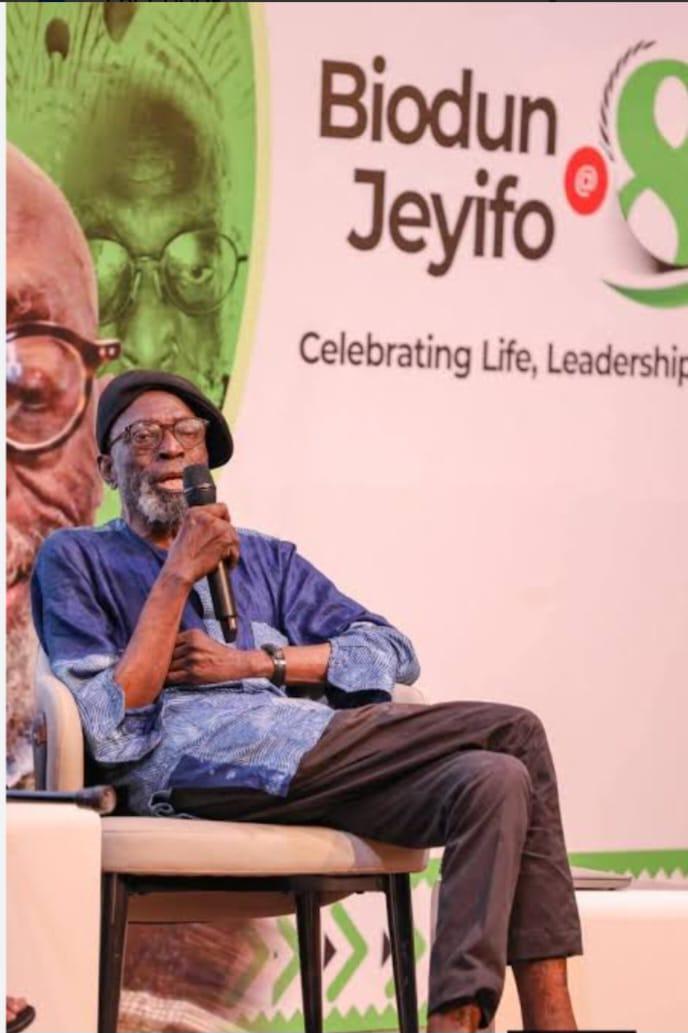
His 80th birthday celebration at the Muson Centre, Lagos, took me directly to his presence. We embraced like father and son (a prodigal son who strayed away from his father’s orbit of influence), and with his sharp eyes digging into mine in an attempt to recognise me. When I told him, “Great Ife,” his eyes lit up, widening in joy, and he said to me in Yoruba: “Eyin na a dagba!” (You too shall grow old). To which I replied: “Amin, sir. E se sir” (Amen,sir, thank you, sir)
The reason why I never came under his influence was basically because I was never preoccupied with his literary works essentially because I was engaged with different preoccupation then. I only came to start appreciating who he was, what he stood for and his legacies after becoming a bit older with settled mind to give enough attention to other people’s work, and having tasted from different pots of some other disciplines. Literature was the next port of call!
BJ stood as a literary firebrand, an epitome of discipline and confidence in himself and what man is capable of achieving once he decides and dedicates himself to a particular cause – himself as an archetypal example despite his physical challenge of ill-health. To have survived to his 80th birthday fully conscious of himself and his environment under that harrowing ill-health conditions until his dying days is salutory – a salute to steadfastness, loyalty to fidelity of his cause, character intrepidity (resilience of the human spirit), a spirit of “never say die”!
Every society or country is never without its own Biodun Jeyifo, and many of his likes in various fields of human and academic endeavours and social engagements – although many of them are often rare breeds. But the worst sin is when these categories of people are not sufficiently recognised for who they are and are not celebrated enough. The carnivorous State that feast on its kind jumps into the arena of praise when the icon has already departed the flesh into the Greater Beyond and started pouring eulogies into a basket like water! Fie!
Such intellectual avatars come with their peculiar characters, resonances, influence, nuances, and even dislikes. The totality of their individual Beings must be taken as a whole complex phenomenon as it was in which lies the very Essence of their Beings.
A vacuum is always created with the passage of such a Being in a society or country. It is exactly like a giant tree falling off in the forest. It would take some time before the void will be filled. That is often the period when the Personnage is most deeply missed as it would be in the passage of BJ.
BJ passed on just barely five weeks after his 80th birthday. He celebrated his 80th birthday on January 5th, 2026, and passed on February 11th, 2026.
To mark the occasion, friends, colleagues, and well-wishers have gathered at the Muson Centre, Onikan, Lagos to celebrate the literary icon. Baba Kongi was even there, though he did not stay long nor even spoke at all. The celebration organised by the Wole Soyinka Centre for Investigative Journalism (WSCIJ) drew hundreds of participants from all directions. Professor Priyamvada Gopal, BJ’s former PhD. student who has also now become an international figure (Professor of Post-Colonial Studies at Cambridge University), was the keynote speaker. She delivered an address in which she challenged some of the orthodox and dominant paradigmatic literary themes in the global community. (See Alexander Ekemenah: Professor Biodun Jeyifo @ 80: A Gathering of the Titans…)
During the celebration, Dr Yemi Ogunbiyi, BJ’s closest associate, said (I am not quoting his exact words) that BJ was not meant to live up to 80 years at all; that it was a miracle that he did, and that was the very reason why the celebration was significant – to show BJ himself how much he was loved by his friends who had travelled far and wide to be with him on that auspicious occasion.
Nobody could have predicted that that would be final farewell for this eponymous intellectual. No Nostradamus or an Asimov could predict that it was a round-up party for him. The vivifying joy and happiness of life overwhelmed and overshadowed such subliminal suspicion of death lurking around the corner waiting to grab him by the throat and drag him off into the Greater Beyond. It was all joy pulsating like a musical filigree through the Muson Centre on that day.
Biodun Jeyifo was further hosted and celebrated by his inner circle of friends at Ibadan.
Who is a Public Intellectual?
When a Biodun Jeyifo is referred to as a public intellectual, what exactly does that mean?
A public intellectual is an advocate for public good or commonwealth in whatever areas of social life that he or she chooses to be actively engaged in. A public intellectual must evince selflessness or altruism that convinces the public to follow him/her in his/her advocacy.
Public intellectuals are not just the gatekeepers and guardians of society. They are also the conscience of society upholding the moral fibre of society, filtering off drosses and/or impurities from further contaminating the moral fibre or membrane of the society. Theirs are a nuanced spiritual order, ordinance, and practice (or rituals). There is no society without its pool of public intellectuals.
This is why the fall of a public intellectual from his/her commanding height of his/her embodied morality is the most dangerous and dreaded thing that can happen to the person involved and the society concerned. It is like the fall of an archangel or angel from the heavens! A turncoat or a traitor to his/her own hitherto convictions and belief system! That is the most dangerous and dreadful thing. It’s apostasy!
Biodun Jeyifo stood faithfully throughout his lifetime like a Sentinel to his own (whether you agree with him or not), cause of public good , to the cause of Justice, and love for his community and nation, for Africa and the entire Black race. He stood for what is best of and for humanity. He finally laid down his life as a bridge for cross-cultural interfacing and embracing from the lowest to the highest height of the intellectual and literary worlds.
It is fullfilment of a sacrament or covenant!
It was in 1961 that Paul A. Baran (1961) (Professor of Economics at Standford University, California) made what seems to be an axiomatic analysis of the qualities that make intellectualism a calling as well as a vocation. The content is so convincing that many branches of the Nigerian’s Academic Staff Union of Universities, ASUU often quote it. Titled “The Commitment of the Intellectual,” the piece provides answers to the all-time questions concerning the ideological springboard and etiquette the intellectuals should exude while practising their job.
Intrinsically, Baran submits that the intellectual must not only be desirous of the pursuit of truth in their lives but must also be bold enough to speak out in order to ‘help overcome the obstacles barring the attainment of a better, more humane and more rational social order’. This commitment to truthfulness enables an intellectual to command the respect of right-thinking members of the public; and, conversely, lays them in a collision course with the powers that be who dismiss this social category of the learned as self-opinionated ‘troublemakers’ and societal ‘nuisance’. … (These are not my exact words)
In “The Study of Society: An Introduction to Sociology,” Stephen Cotgrove (1978) also identifies a variant of the social category of intellectuals. This is made of people that work with their brains in the fashion of what Baran had described as ‘intellect workers’ whose moral and ethical principles tend to serve their own personal or class interests more than the spirit that guides intellectualism. Seeing academic life as utopian, they convert intellectualism to a professional tool for the search and acquisition of greener pasture. (Again, not my exact quote).
But exactly did Baran say?
The oft-quoted part of Baran’s article are two paragraphs to the last:
“The desire to tell the truth is therefore the only one condition for being an intellectual. The other is courage, readiness to carry on rational inquiry to wherever it may lead, to undertake “ruthless criticism of everything that exists, ruthless in the sense that the criticism will not shrink either from its own conclusions or from conflict with the powers that be.” (Marx) An intellectual is thus in essence a social critic, a person whose concern is to identify, to analyse, and in this way to help overcome the obstacles barring the way to the attainment of a better, more humane, and more rational social order. As such, he becomes the conscience of the society and the spokesman of such progressive forces as it contains in any given period of history. And as such he is inevitably considered a “troublemaker” and a “nuissance” by the ruling class seeking to preserve the status quo, as well as by the intellect workers in its service who accuse the intellectual of being utopian or metaphysical at best, subversive or seditious at worst.
“The more reactionary a ruling class, the more obvious it becomes that the social order over which it presides has turned into an impediment to human liberation, the more is its ideology taken over by anti-intellectualism, irrationalism, and superstition. And by the same token, the more difficult it becomes for the intellectual to withstand the social pressures brought upon him, to avoid surrendering to the ruling ideology and succumbing to the intellect workers comfortable and lucrative conformity. Under such conditions, it becomes a matter of supreme importance and urgency to insist on the function and to stress the commitment of the intellectual. For it is under such conditions that it falls to his lot, noth as a responsibility and as a privilege, to save from extinction the tradition of humanism, reason, and progress that constitutes our most valuable inheritance from the entire history of mankind.” (Paul Baran: “The Commitment of the Intellectual”, Address delivered to the American Association for the Advancement of Science in New York on December 27, 1960, as published in Monthly Review, February, 1961, p.507)
Has there been any change in the socio-political environment in Nigeria today that could be described as negating what Baran said above? Can we see BJ in the vanguard of this public intellectualism as described by Baran above?
BJ and Military Rule
BJ’s total hostility to military rule (from the standpoint of his Marxist or left-wing revolutionary convictions) reached its peak in 1987 when he had to leave Ife and the shores of Nigeria to the United States. This was not an act of cowardice, such as the fear of being detained without trial or even physical elimination of his person, but a safety mechanism to continue to uphold the revolutionary torch.
I would like to suggest here that it was the Ibrahim Badamasi Babangida-led military dictatorship of 1985-1993 that drove the likes of BJ into a kind of self-exile in those halycion days. Further, the exodus of radical political actors was to follow later in 1993-94 under Sani Abacha-led military junta.
Military rule nearly ruined Nigeria
BJ never really looked back – although this is said with a caveat. He took residence in the US, and his homecoming became infrequent until Babangida left power, including Abacha and Abdulsalam Abubakar under whom military rule reached its peak in Nigeria and an anti-climax that gave birth to democracy and democratic rule in 1999.
Today, the most worrisome aspect of the struggle for the enthronement of democratic rule is that democracy has suffered a setback under the kind of leaders thrown up into leadership positions. It has been a severe blow to the understanding of the basic tenets of democracy and the convictions that democracy is the only form of government that can serve the people and drive the economic development on a faster pace. Alas! The emergent political class utterly disappointed the nation and people, dashed the hopes invested in democratic experiment and for which many people lost their lives during the struggle for enthronement of democratic rule under the siege of military juntas.
Worst still, however, while this struggle for the soul of the nation is going on, some elements still have the temerity to suggest or even canvass in beer parlours and on the streets for the return of military rule after the wholesome damage it had done to this country and its future. It’s an inconceivable insanity of a magnitude that cannot be described in words on the part of these misguided elements to call for return to military rule because of the current travails of democratic rule in the country.
A simulacrum or exegetical exposition of BJ’s literary works shows BJ’s explicit rejection of military rule and his firm conviction in democracy and democratic rule – maybe with the caveat that this democratic rule should be under a revolutionary leadership and guidance.
Yes. The civilian rulers deserve the harshest criticisms they can receive because they have been sources of more pains than joys. Their criminal and/or clumsy handling of management of state affairs: economy, politics, society, science, and technology accompanied by their horrifying and stupefying corrupt practice, ethno-religious jingoism and gross public misconducts leaves much to be desired.
BJ never canvassed for return to military rule no matter the abhorrent or appalling incompetence or even idiocy displayed by our current civilian rulers. Everything in him rebelled against military rule or a return to such under any excuse. His Talakawa Liberation Forum series in the Guardian newspapers for many years published as a compendium titled “Against the Predators’ Republic” in 2016 by Carolina Academic Press is a testament to this absolute rejection of military rule.
The Challenge of Understanding BJ
BJ was an enigma yet to be fully unfolded and understood in his life and works. This is why it is imperative that a comprehensive study on him be carried out – precisely like when he single-handedly chested the task of unveiling Wole Soyinka to us in his eponymous work on him.
Such work on BJ would be a gift to posterity, that a Titan once passed through this realm. It would be a simulacra or exegetical exposition of his life and works. It would be a biographical work either by an individual or a team of writers.
Further inspiration can be taken from Isaac Deutscher’s epic biographical work on Leon Trotsky (1875-1940) (Prophet Armed, Prophet Unarmed and Prophet Outcast) including Joseph Stalin and his unfinished work on Lenin.
These were by a single individual. So who will bell the cat in the case of Biodun Jeyifo in his life and works?
Adieu
Erin wo! Ajanaku ti nmi Igbo kiji kij!
Eni ire lo! O di arin nako! O di oju ala! O di owuro! O di igboose!
Ibadan Mesiogo! E ku oro eniyan!
Baba Kongi! E ku oro eniyan!
Ojogbon Yemi Ogunbiyi! E ku oro eniyan!
Professor Ropo Sekoni! E ku oro eniyan!
Professor Toyin Falola! E ku oro eniyan!
Professor Femi Osofisan! E ku oro eniyan!
Professor Niyi Osundare! E ku oro eniyan!
Professor Ralph Akinfeleye! E ku oro eniyan!
Professor Duro Oni! E ku oro eniyan!
Professor Priyamvada Gopal, Pele mai dia! O ku oro eniyan!
Professor Chima Anyadike! E ku oro eniyan!
Ojogbon Bisi Anyadike! E ku oro eniyan!
Ojogbon Wale Okediran! E ku oro eniyan!
Amofin agba Femi Falana! E ku oro eniyan!
Ogbeni Kunle Ajibade! E ku oro eniyan!
Ogbeni Dapo Olorunyommi! E ku oro eniyan!
Ogbeni Sam Omatseye! E ku oro eniyan!
Amofin Ogaga Ifowodo! E ku oro eniyan!
Gbogbo awon omo Baba Biodun Jeyifo! E ku oro eniyan!
Gbogbo awon molebi Baba Biodun Jeyifo! E ku oro eniyan!
Gbogbo awon ore ati ojulumo Baba Biodun Jeyifo! E ku oro eniyan oooo!
Eyin Baba wa, Biodun Jeyifo, a dara o!
Ojo a jinna si ara won oooo!
May the spirit of Biodun jeyifo awaken to joyful consciousness of existence in the Greater Beyond! May his consciousness expand further in the vast realms of his Creator! May his spirit be completely freed from all negative vibrations from the earthly plane so that his spirit can soar upward to more Luminous Realm of his Creator!
May what he spent his entire earthy life fighting for (justice, equity, fairness, and love) never be in vain in Nigeria, Africa, among the Black race and the entire world! May his legacy of honesty and selfless public service live on!
- Alexander Ekemenah is the Chief Analyst of NextMoney magazine and online (nextmoneyng.com). He is a global affairs analyst and writes on strategic issues and industrial-related developments including soft human stories. He can be reached via +234 816 897 5679 (WhatsApp) and +234 705 678 0050 and alexekemenah@gmail.com

