

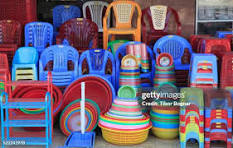
Plastic products such as household plastic items, gift items, cups, toys, seats, tables, bags, etc. are daily consumables. The demand is very high that the available producers in the country cannot satisfy the market.
Apart from local buyers, the entire ECOWAS sub region rely wholly on Nigeria for their plastic wares.
This is not surprising because all the raw materials for production of quality plastic products are locally available and at affordable prices.
In this investment profile prospective investors are educated on how to invest successfully in this lucrative venture putting all the necessary inputs into consideration such as technical, marketing, operational and financial requirements into consideration
Plant & machinery
One of the economic efficiencies of measuring the mechanical productivity of plant and machinery of a firm, or a proposed venture, is not only a function of its life span, rate of depreciation, energy consumption per unit of output, but also adoption of a simple plant to produce different quality products.
The plant in mind is capable of producing four varieties of plastic products of desired sizes. What is needed involves fixing different molds into the injection molding plant.
Competition
Survey findings have revealed that most Nigerian industrialists and project promoters are not fully aware of these economic efficiencies of injection molding plant.
The few firms and industries utilizing injection-molding plant that can only produce single plastic product can justify this belief. It implies that the plant in mind would produce different products to meet seasonal demand. This means if there is any project to be considered for implementation in terms of production multiplicity of plant at all, plastic plates, cups, bowls and spoons production should be the one.
Raw material
The major raw materials required are thermo-plastics of high fluidity such as high-density polyethylene and others. The beauty of this project is that both the injection molding plant and raw materials are available locally, which signals the ease of sourcing both the fixed and variable inputs.
Location
Theoretically, this project may be sited in any state in the federation without location constraint of raw material procurement. Project implementation involves acquisition of factory house, purchase and installation of plant and machinery, recruitment of appropriate personnel and other accessories.
Projected cost of establishment
The initial cost of the project is estimated to be N55,800, 000 only as shown below. The project can be scaled down depending on many factors that will be discussed with prospective investors.
Technical feasibility
The production technology of plastic products is simple, though mechanical. The materials suitable for injection molding are thermo-plastics of high fluidity.
The granules are introduced through a hopper, into the cylinder in which they are heated above their softening point, by means of a heating jacket.
Moving piston plasticizers force the material through a nozzle into the mould. Different kinds of moulds are used to produce different plastic products. The extruded material is cooled and is taken off by means of suitable devices designed as to prevent any subsequent deformation.
The theoretical analysis of production technology of plastic products remains the same, but they differ only in terms of time consumption per output, weight and structure morphology.
The plant in mind has production capacity of 4,000 – 4,500 plastics cups per two shifts per day of 5,000 – 6,000 plastic plates per day. This may be packed in dozens for sale. Appointed distributors would be needed for products distribution and sale.
Implementation
There are two markets for plastic products – the domestic and foreign markets. Households in general, canteens, industries, hospitals, clinics and hotels form the domestic market, while the neighbouring West African countries constitute the foreign market.
The market viability shows that plastic plates, cups, bowls and kegs are cheaper and durable when compared with sister glass products with high price disadvantage, and their fragility. More so, the cross elasticity of demand for plastic products shows a perfect elasticity of substitution for glass products in all ramifications of their uses.
For profitability 4,000 plastic cups are assumed per day. Given 250 working days per annum, 83,333 dozens of plastic cups would be produced per year. Assuming a conservative price of N1,500 per dozen, N125 million would be annual gross revenue operating at small scale capacity. In view of the above theoretical facts and figures, this project is strongly recommended for investment.
Implementations
For details on comprehensive and bankable feasibility studies, business plan; procurement and installations of strong and durable machines, packaging methods, export market and funding arrangements, please contact the writer:
Uba, Godwin
56, Ishaga Road (1st floor), Surulere, Lagos
Tel: 08034494437 (WhatsApp), 08023664368
Email: ubagodwin@yahoo.com

