

By Alexander Ekemenah
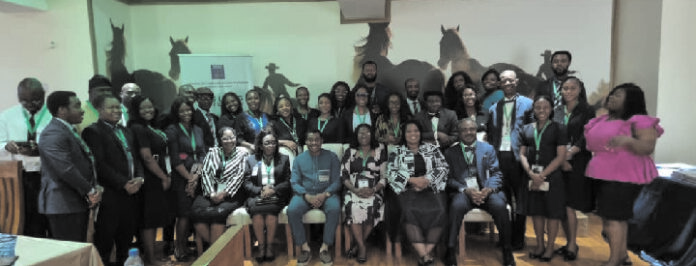
The pristine and serene environment of Babcock University, Ilishan-Remo, Ogun State, was a welcome ambience and embrace to a large number of participants across academic multi-disciplinary domain that had come to participate in the 2025 Legal Technology and Sustainable Development Goals Conference organised and hosted by the Babcock University School of Law and Security Studies.
The 1-day Conference held on Tuesday, June 17, 2025 at the University Guest House turned out not only to be an unforgettable day for the participants but a treasure trove of knowledge gathered through the theme of the Conference itself: Law in the Realm of Technology and Sustainable Development Goals (SDGs): From African Indigenous Knowledge to Artificial Intelligence.
The Conference is the third in the series of International Law Conference in Babcock University.
The subthemes enabled the participants to gather invaluable knowledge across a wide-range field of technology, sustainable development goals, and African indigenous knowledge in the age of artificial intelligence – through the eyes and mind of the law. It was indeed a gold-mine of knowledge which can be further researched upon, refined and stored in the library of African contribution to global scholarship in this particular area.
There were not only physical participants but also dozens of online participants not only from Nigeria but also from other countries.
There were thirty-seven subthemes. A day is probably not enough to cover exhaustively even half of the subthemes.
But under deft management of time, the Conference was able to accommodate nearly all the speakers (both physical and online) to deliver the summaries of their papers.
This was an outstanding achievement given the extensive nature of the papers in terms of number of pages involved.
There were five sessions:
- Intellectual Property, Artificial Intelligence and Traditional Knowledge chaired by Professor Ayoyemi Lawal-Arowolo.
- Industrial and Finance chaired by Professor Vera Ekundayo
- Human Rights and Health Law chaired by Professor Titilayo Aderibigbe
- Data Protection and Privacy Rights chaired by Dr Adekemi Omotubora
- The Environment chaired by Professor Olubukola Olugasa.
Declaring open the Conference, the Senior Vice President and Deputy Vice Chancellor (Academics) of the University, Professor Philemon Amanze, encouraged every attendee to participate in all the sessions of the conference.
“This is because, our facilitators, under the guidance of the Holy Spirit, have prayerfully prepared special presentations for our gathering here.”
Stressing the role of the Holy Spirit as a Faithful Guide in whatever we do, Professor Amanze said this role should also be emphasized during the conference.
“When the Holy Book says: Ask and you will receive, in another section, it says: you do not receive because you have not asked – must be taken seriously during this conference.”
Professor Amanze particular warned against an emerging belief viz: “Artificial Intelligence Is God”, “Robotheism is the only true religion” Professor Amanze said this belief is dangerous and indeed blasphemous and that we should be extremely careful about it.
The Conference, according to the Senior Vice President, sought to provide a platform to bridge the gap existing between the following:
- The synergy between IP, AI and ATK
- The Nigerian Judiciary & Economic Crimes: Causes, consequences and solutions.
- Human Rights and Health Laws
- African traditional medical practice and the law
- African Indigenous knowledge and myth in the age of Artificial Intelligence
- Global economy and the protection of African traditional knowledge system.
In her welcome address, the Provost and Dean of School of Law and Security Studies, Professor Dorcas Odunaike said the theme resonates profoundly in our contemporary context of AI-generated creativity, Blockchain and Cryptocurrency.
“In our world today, the intersections of law, technology and sustainable development are shaping the future of governance, innovation and justice.
“From the wisdom embedded in African indigenous knowledge systems to the transformative power of artificial intelligence, this conference offers a platform to explore how legal frameworks can support sustainable growth in a rapidly changing world.
“Nigeria’s rich indigenous knowledge systems, such as community-based dispute resolution and traditional medicine, have long supported sustainable living. At the same time, rapidly growing digital technologies including artificial intelligence, fintech, and e-governance, are transforming everyday life.
“This dual reality presents a legal challenge: how to create sustainable legal frameworks that protect indigenous intellectual property, ensure ethical use of emerging technologies, and bridge the rural-urban digital divide.
Odunaike further stated that as Nigeria increasingly uses technology to address challenges in education, health, and agriculture, “the legal framework must act as both a safeguard and an enabler, ensuring that innovation promotes justice, sustainability, and respect for human rights.”
- Alex Ekemenah is the Chief Analyst of NextMoney and can be reached via 08168975679 or alexekemenah@gmail.com

